I slept for some eight hours, waking just once and soon slipping back to sleep soon after.
So, I woke up, finding it still dark. What would the time be: five? Six?
It was twenty past six, and time to get up, and be ready for breakfast at seven, so to beat the rush.
We same three who met the previous two mornings were there, so we sat at the same table and chatted. About churches.
Back to the room to pack, check, and recheck the room to make sure I hadn't left anything behind.
Down at reception at five past nine, no bill to pay, so wait outside for the coach to come and the driver load our cases, then to be ready to move just before nine.
One member of the tour, the guy I helped the day before, decided to drive home, so we waved him off, then the coach back up and we turned for the city, and the short drive to the first church.

Daybrook used to have one of the largest breweries in the city, and the owner's money went partly on the chuch.
St Paul is a huge Victorian building, partly Gothic, with a tower reaching for the heavens.
But the keyholder wasn't there, so we waited on the street until the doors magically swung open.
It is a magnificent Victorian church, John says is one of the best and largest of its type, the type that are scattered across London, and towns and cities up and down the land.
The windows were excellent, and I took approx 300 shots of them!
Nearby is the suburb, as it is now, of Arnold.
St Mary is an ancient parish, and the church is late 13thC and early 14th. Prize item of interest here is an Easter Sepulchre on the north wall of the Chancel.

After introduction to the church, we were left to explore and taker shots, while there was tea and coffee on offer, and the church was filled with the sound of joyful chatter, our hosts smiled to see their church full with people who also loved the building.
Another short drive away, is Papplewick.
Yes, Papplewick.
We were dropped off on a bend, then left with a five minute walk up a long path to the church, which was hiding behind a huge yew tree, that was surrounded by a circular bench.
The church, a small Georgian affair.
I mean, who hasn't enjoyed a small Georgian affair?
Narrow with pews on either side, and a wafer thin gallery on the west end and north side, leading almost to the Chancel.

We were given a short potted history of the church, then allowed to take shots. Exploring wouldn't take long.
Back along the path to the coach, and on the way I snapped several flowering native plants: White deadnettle, Red deadnettle, Shepherd's purse, and Common groundsel.
The vicar from Papplewick also looks after Linby, so he followed us in his car, so to open the church for us.
Which would have been great if he had remembered to bring the church keys with him.
There was a short delay while he ran over to the churchwarden's house for a spare set, then opened up the small church for us.
Another ancient, part Saxon church, now stripped of its plastered walls, so the rough Saxon coursework turns to neater Norman work further up the walls.

A pair of Saxon arches was on the south wall of the Chancel, very much the twin of the same at lyminge.
Time was now getting away from us, especially as we were to be back at Nottingham station for half two, so to be able to catch the ten to three train.
Just one last church of the day, tour, and indeed, the final church John would take a tour round, as he retires once this tour finishes.
Into the centre of Hucknall for this then, the final church.
St Mary sits on the edge of a small square, opposite the stops for what counts as the bus station. Its fencing has been covered in knitted poppies of all sizes, and looked magnificent in the strong, low sunshine.

Inside, there were three things to enjoy: one, an almost complete set of Kempe windows, and most early unsigned ones at that too. Second, the burial place of Lord Byron of Rochdale. Yes, that Lord Byron; mad, bad and dangerous to know. And lastly, the burial place of his daughter, Ada, later Ada Lovelace, the mother of modern computing.
A café took up on transept, and the rest was quite busy, but the windows high enough for us to enjoy while not having others get in the way.
There was a LOT about Byron, of whom I know little other than his reputation.
We only had half an hour, and soon the sands of time had run out, so we walked back to the coach.
John said a few words once we were all on board, remarking his fifty years leading tours, and how grateful he was for those that attended, many every tour, but also for the time off he will now enjoy.
The bus took us back to Nottingham, round the one way system, and dropping us near to the back entrance of the station.
I grabbed by case, walked to the entrance, up the stairs to the footbridge, and found a train to London leaving at 14:12.
It was 14:11.
I ran down onto platform 3, and found all standard class carriages packed, not being able to get in the doors, due to the number of passengers already aboard.
I went to first class, and found I could upgrade for £21, and get free drinks and a snack meal. And a seat.
I paid and slumped into the seat as the train pulled out, an a guy brought me a tea as well as a small bag of crips and a shortbread biscuits.
We rolled through Loughborough to Leicester and Market Harborough before going non-stop to London.
I ate as the countryside rolled by.
Stations flashed by so quickly I couldn't make out their names, but soon we rolled through Luton slower so I could read its name, and I guess the Parkway station for the airport too.
Into London, and a walk to the end of the platform, down the escalators, under the Eurostar platforms and I saw tat a train to Dover was due to leave at 16:04.
Damn, missed it.
Then I saw delayed to 16:07.
It was 16:06.
I went up to the platform, seeing that nice Mr Robin Ince on the way up. And on the upper level I saw the train still at the platform, and doors still open.
I flashed my ticket, ran to the train and got on, the buzzer sounded and the doors closed.
I would be back in Dover at twenty past five!
I called Jools and she would meet me at priory, and once people got off at Statford, I even had a seat.
Even if I did have to get off at Ashford to get on the first six coaches at the train split, but made it, had a seat, and on the last leg home.
Jools was waiting, we picked up a Chinese meal from Ladywell, then back home up Jubilee Way for supper and a beer.
Phew.
 This meant on weekdays being at the doors for six, and seven at weekends.
 One of which was a reworking of "You've Got the Love", which was itself a reworking and mash up of two older songs: an instrumental, and a vocal by Candi Staton. That was a hit when I was going through trade training in 1991, and I remember it booming out of boomboxes as we bulled and studied.
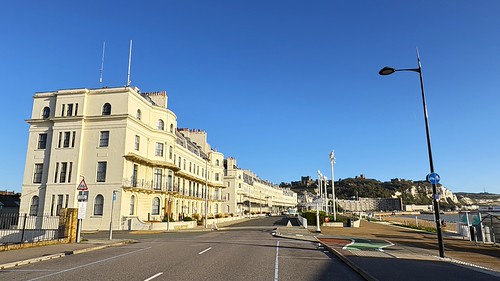
 We both did our fifty minutes, then after a short cooling down outside in the sunshine, we went to Tesco to fill the car up, then to the Promenade for a walk.
 In a change from the two previous days, and the two following days, Sunday was gloriously sunny, though with a stiff westerly.
 So we saved our money and walked back to the car, me doing some light botanising on the way on the few flowering plants on the edge of the stony beach, before reaching the car and climbing in.
 A quiet morning, so we drove back to Townwall Street, then along to the port and up Jubilee Way, free of traffic as there were no ferries in.
 Once home we put the kettle on, and in a change had a shortcake each which I had made between halves of football the previous day.
 And a very good start to the day it was.
 Lunch was our old favourite of chorizo hash, all prepared, cooked and eaten before kick off at two, at which point the week of preparation for Man Utd was for naught, as opposition, Bournemouth, had already in the six days before beaten both Sunderland and AC Milan (!), so the current iteration of The Red Devils would pose no serious issues.
 So it was that Russian monied Bournemouth cruised to a 3-0 victory, and on another day might have scored more. In their last four visits they have won 3-0 three times and had a 4-4 draw!