I overslept to ten past seven, so got up and went down for breakfast, then back to the room so to keep on top of the blog and shots.
Batteries needed charging, shots needed backing up, and the other stuff, so that come half nine, we all gathered out the front of the hotel and boarded the coach.
We rolled through the campus, and edged out onto the main road, heading to the outskirts of the city to Wollaton, where we parked near the village shelter/market cross, with a fine looking pub and the church behind the coach.
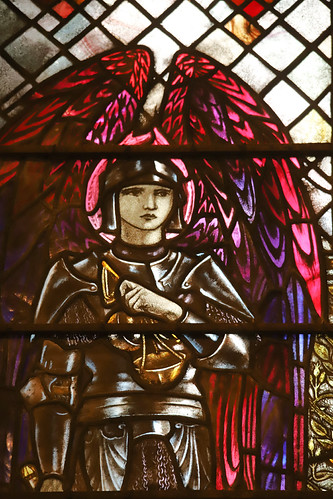 The overcast day meant a series of gloomy and dark churches was to follow, and I did my best with the stained glass at St Leonard. Particularly fine was a pair of adjacent windows o featuring St George and St Michael the Archangel, though the colours were really vibrant with your eye.
Another highlight were two cadaver tombs, though the second had the figure hidden behind carved screen making it almost impossible to see and photograph.
Back on the coach for the short drive to Stapleford, a busy village-cum-suburb where our driver dropped us off on the side of the main street, leaving us to dash between the traffic to the church.
 Highlight here was in the churchyard, the Saxon Stapleford Cross, grade 1 listed.
While inside a comprehensive introduction to the church and its history meant we only had a few minutes to explore the church before we had to leave and board the bus.
We then had a half hour drive through more industrial, and post industrial towns and landscapes, crossing the main line and Erewash into Derbyshire.
Up through the village of Sandiacre, up and up, along a narrow residential street, then over a crossroad up into Church Lane, a dead end lane that the coach could barely get up.
At the top site St Giles, overlooking the valley into Nottinghamshire and its village.
Through the churchyard filled with stones standing at all angles, except straight, and into the porch, through into the church where we were confronted by a Norman chancel arch, with a dazzling Victorian east window beyond.
In pillars supporting the arch, on one side a carving that might be of either a ghost or a dragon, and on the other side, the famous Sandiacre Imp, a bug-eyed alien figure.
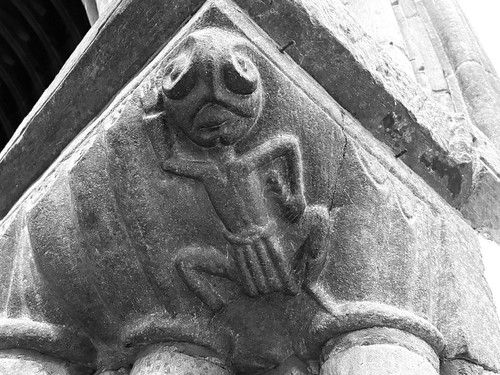 A short talk was given of the history, then we were allowed to explore and take shots.
Up the hill and over the M1 was our lunch stop: The Stanhope Arms, where our coach almost blocked the road through the village. Upstairs was a buffet meal, where we took a break from churches and snapping.
Back into Nottinghamshire, and on a road in rolling parkland sits All Saints.
The rain had still yet to arrive, so we made hay with our fourth church of the day.
 In the Chancel beyond, underneath a painted ceiling, six misericords, two with carvings on the seats, one was a Sheela-na-gig, though some parts were missing, and hidden between each seat were carved faces, crudely done, easily missed.
Coffee and chocolate digestives were provided by the warden, making a most excellent visit.
Beside a main road sits St Patrick. Built of sandy-coloured stone, its the tower that takes the eye. Almost castle-like, not so tall, but squat. And it is the tower, or the lower courses of stones that is the oldest.
 Inside the church has a fine Rood Screen, the lower half Victorian, but the upper half much older, and has carved beasts if you look carefully.
In a nice touch, it has some fine 20th century pews, each with modest carvings on the end, but one was a Green Man, something also easily overlooked.
Its always the details.
Back into Nottingham now, as the evening drew in early, mixing with heavy rush hour traffic, which took us past former lace factories, and other former industrial sites now retail units or super gyms.
Holy Trinity sits down a quiet street, a huge Victorian pile that dots cities and large town all over the country.
These are rarely unlocked, but this was for us.
Inside, the church is mostly now a community space, with no pews or chairs laid out, instead there are stacks of metal framed chairs to position where needed.
It is a huge space, with fine windows, but the gathering gloom meant those on the north wall were impossible to photograph well, though enough light to the south to get shots of the windows there.
 Most impressive here is the 11th century Romanesque font, brought from a nearby monastery, and looks very out of place in its modern surroundings. Its square, or almost, and highly carved, but worn, on all four sides.
It is a remarkable survivor, and more remarkable to find it in Holy Trinity.
Outside it was almost dark, and the rain had begun to fall. We climbed back onto the coach, and our driver took us back the short drive to the hotel, giving us 90 minutes before dinner to relax, and do admin.
The restaurant was crazy busy, and the food took some time to arrive, and as is common in such places, portions not generous, but the food good.


No comments:
Post a Comment